Three startups to build in resumes
A tool nobody calls exciting has quietly billed $9.6 million on Stripe. Here is where it leaves the door open.
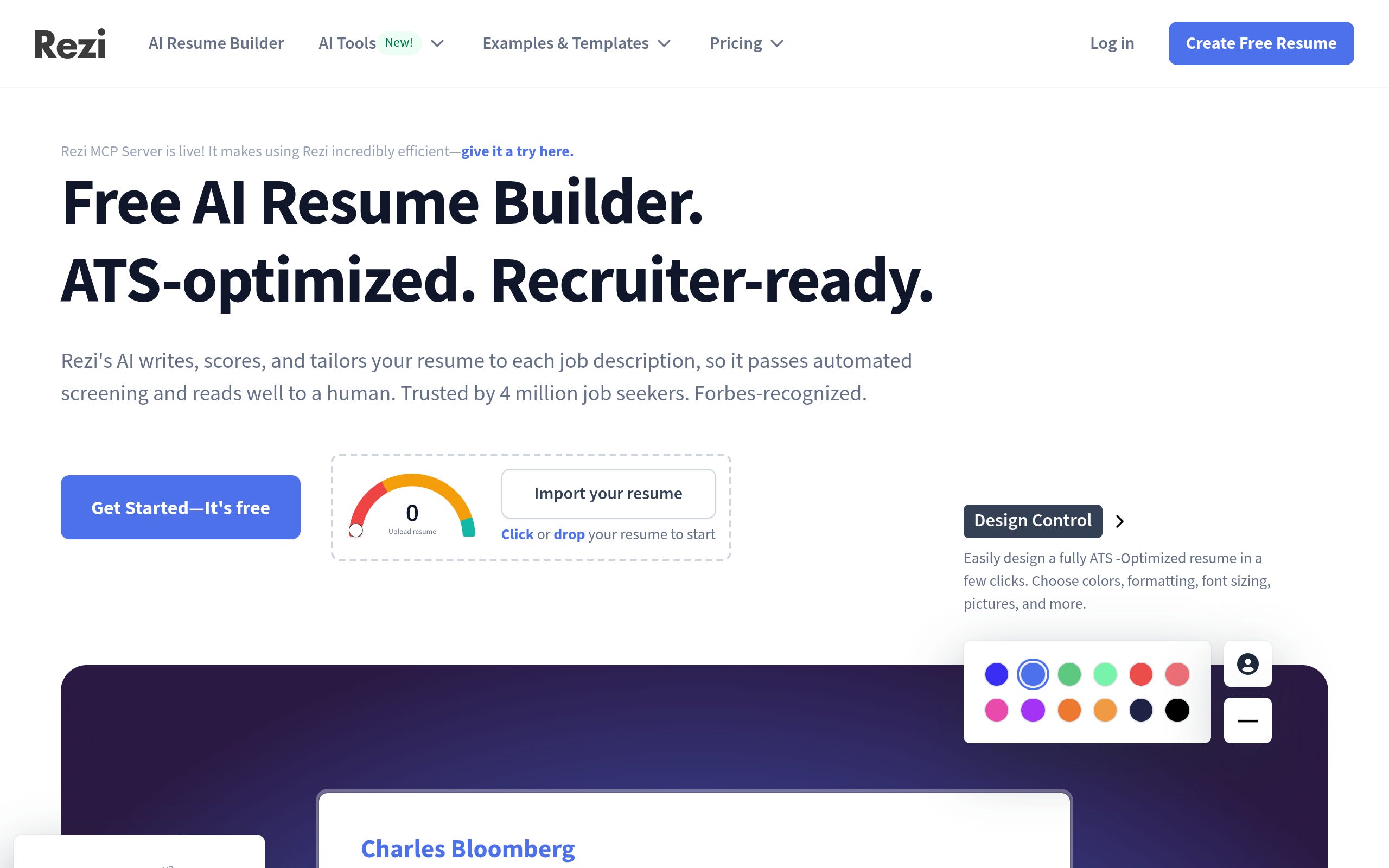
[rezi.ai](https://www.rezi.ai) - the free resume builder that has taken in $9.6M
REVENUE VERIFIED BY STRIPE · LAST 30 DAYS$241,940Rezi · AI resume builder · founded 2015 · $9.6M all-time · 10,759 paying subscribersCheck the numbers yourself: [trustmrr.com/startup/rezi](https://trustmrr.com/startup/rezi)
The resume-builder tool market is about $1.8 billion in 2026, and it is growing roughly 9.5% a year.
Rezi proves the category prints money. One AI resume tool, four million users, and a quarter of a million dollars a month on Stripe. It sits next to Zety, Resume.io, Teal, and Canva, all fighting over the same job: help anyone write a clean, ATS-friendly resume.
That is the tell. "Anyone" is a horizontal. And a horizontal always leaves sharp corners uncovered.
Here are three of them. Each is a different kind of job seeker Rezi treats exactly like everyone else, and each is having a very specific, very timely reason to look for help right now.
THE THREE PLAYS
1. The federal-transition resume builder
317,000 federal workers lost their jobs in a single year. Their five-page government resumes do not work anywhere else.
- Who: Displaced federal employees and transitioning military veterans, moving between government and the private sector.
- Gap: Rezi, Zety, and Resume.io only build the private one-page resume. None understand the USAJOBS format: GS grades, hours per week, KSAs, five pages, clearance lines. It is a different document.
- Build: A two-way converter. Federal to private cuts a five-page GS resume down to a one-page ATS resume. Private to federal expands it into a compliant USAJOBS resume with the KSAs and required fields. Templates by job series and clearance level.
- Price:
$29–99 one-timeor$19/mo.
- Why now: The federal workforce shrank by more than 317,000 people in 2025, a 13.7% drop, with 322,000 separations between January and November. That entire pool is job-hunting at once.
- Wedge: It speaks both dialects. A human federal resume writer charges $200 to $600 and takes a week. This does it in an hour for a fraction.
2. The German-market CV builder
Germany opened a one-year job-search visa for skilled foreigners. Their US-style resumes get them screened out.
- Who: Non-EU skilled workers in IT, engineering, nursing, and construction moving to Germany on the Opportunity Card.
- Gap: Rezi and Zety build the American one-pager. Germany expects a tabular Lebenslauf, often with a photo, a date of birth, and a signature. Europass exists but is generic and clunky. Nobody builds the German CV plus the application, in English, for someone who does not speak the language yet.
- Build: German Lebenslauf templates that match local norms. A guided flow for the Opportunity Card points system. Auto-translation of the resume into German. A cover letter in the German Anschreiben format. Integration with StepStone and Xing.
- Price:
€19–49/moor a€39one-time CV pack.
- Why now: Germany launched the Opportunity Card on June 1, 2024. The country needs about 400,000 skilled immigrants a year, and roughly 370,000 skilled jobs sat unfilled in 2025.
- Wedge: Built for German hiring, not a US template with the labels swapped. It produces the format a German recruiter expects on the first try.
3. The career-outcomes platform for schools
New-grad unemployment is the worst since 2013. Schools are desperate to prove their degree still pays off.
- Who: University career centers, coding bootcamps, and workforce programs that have to show placement outcomes.
- Gap: Rezi Enterprise sells schools a resume tool as one feature. Handshake is an employer network. Symplicity runs the back office. None of them own the individual student's path from resume to hired, with outcomes the school can actually report.
- Build: Per-student AI resume and job-matching. An employer pipeline. Placement and outcome tracking that exports the reports the school needs, white-labeled to its brand.
- Price:
$3,000–25,000/yrper institution, by enrollment.
- Why now: Recent-grad unemployment hit 5.8% in March 2025, the highest since 2013, and about 43% of young grads are underemployed. AI is eating the entry-level jobs they used to get, so schools are under real pressure to prove the degree still works.
- Wedge: It owns the outcome, not just the logistics. The school gets placements it can prove, not one more job board to log into.
WHERE TO START
Start with the federal-transition builder, number one.
It is the most urgent, and it has the biggest fresh pool of customers in the country. More than 300,000 people left federal service this year, and most are moving one direction: out.
Here is the first step this week. Go to r/fednews and LinkedIn, find twenty people who left the government in 2025, and ask each one to walk you through the last resume they sent. Build the federal-to-private converter first. That is the door 300,000 people are walking through right now.
Want the full build plan for one of these? Reply 1, 2, or 3 and we'll send it, free.
Forward this to the friend who keeps threatening to quit their job and build something. Tomorrow: another verified number, three more ideas.